Türkiye's 2027–2029 Medium-Term Program: what the inflation, growth and budget path says
The new Medium-Term Program updates the 2026 year-end inflation estimate to 28.4% and maps a 2027–2029 path of faster growth, single-digit inflation and a renewed narrowing of the budget deficit. Here is how to distinguish estimates from targets.
In this article
Quick answer: what is the program's main message?
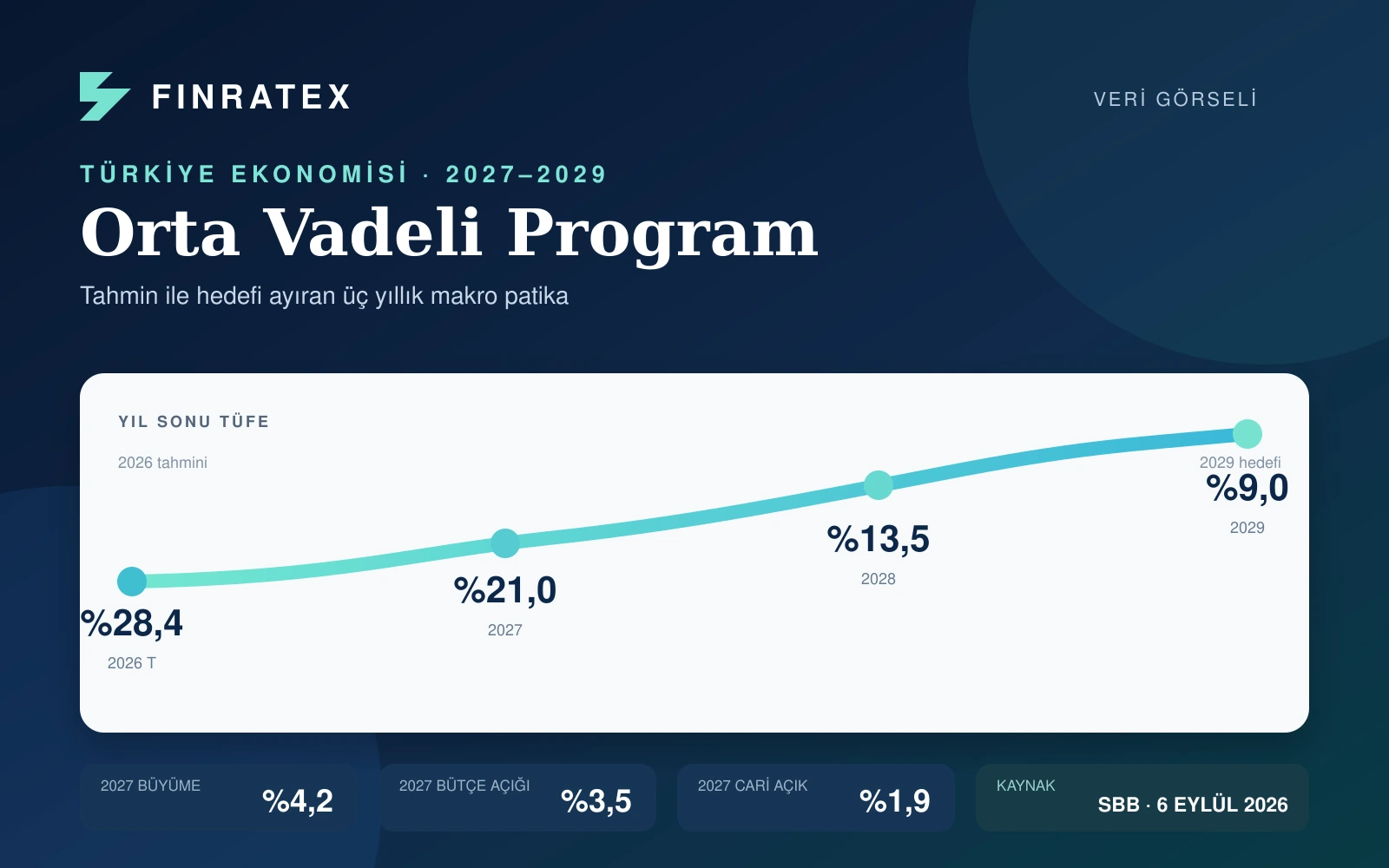
Türkiye's 2027–2029 Medium-Term Program estimates 3.3% real growth and 28.4% year-end consumer inflation for 2026. It then targets a rise in growth from 4.2% in 2027 to 5% in 2029, while year-end inflation falls to 21%, 13.5% and 9% across the three program years. These are not guaranteed outcomes; they form the official framework used for fiscal planning and policy coordination.
Do not confuse the 2026 estimate with the 2027–2029 targets
The 2026 column is explicitly labelled an estimate, while the following three years are program projections. The 28.4% figure is therefore the expected year-end inflation rate for 2026; 21%, 13.5% and 9% are the program targets for 2027, 2028 and 2029. The same distinction applies to growth: 3.3% is the 2026 estimate, followed by targets of 4.2%, 4.6% and 5%.
How can faster growth sit alongside disinflation?
The program links a gradual acceleration in growth to productivity, investment, exports and the digital and green transitions rather than to an indiscriminate rise in demand. Total fixed investment is projected to grow 4% in 2027, 4.7% in 2028 and 5.1% in 2029. For markets, the critical test is whether growth is led by productive investment and external demand, because the composition of activity matters for both inflation and the current account.
Why should the current-account and oil assumptions be read together?
The program assumes average Brent prices of $88 in 2026, $76 in 2027, $72 in 2028 and $67 in 2029. The current-account deficit is projected at 2.6%, 1.9%, 1.8% and 1.6% of GDP over the same years. As Türkiye is a net energy importer, oil is a shared input into the trade deficit, fuel costs and inflation. A persistently higher oil path could place upward pressure on both the external balance and the inflation trajectory.
Why does the budget deficit rise first in 2027?
The central-government budget deficit is estimated at 3.1% of GDP in 2026, targeted to rise to 3.5% in 2027 and then narrow to 3.1% in 2028 and 2.8% in 2029. The document says reconstruction in the earthquake region and investment supporting productive capacity will continue in 2027. The primary balance is targeted to improve from a 0.1% surplus in 2027 to a 0.6% surplus in 2029.
Does the program publish an exchange-rate target?
No. The tables show nominal GDP in both lira and US dollars, but they do not publish an official year-end USD/TRY target. Dividing those two series may approximate an implied average exchange-rate assumption; it is not a market forecast, a year-end objective or a trading level. Treating the program's macro path as a stand-alone price target for currencies, bonds or equities would be misleading.
Which releases will test the path?
Monthly CPI and core measures will test disinflation; industrial production, retail sales and quarterly GDP will show the composition of growth; budget results will track fiscal space; and trade plus balance-of-payments data will test the current-account assumption. Brent and trading-partner growth are the two major external checkpoints. The program should be compared with incoming data as it is released. This article is not investment advice.
Related analysis
All news → Gold, energy and commodities
Türkiye fuel prices on September 7, 2026: why diesel is moving differently
 Gold, energy and commodities
Fed minutes are out: what comes next for gold and the dollar after 3.75%–4% rates?
 Money and banking