US stock market hours: the October 25–November 1, 2026 clock-change guide
Türkiye keeps its clock unchanged. The US session moves to 17:30 in Istanbul on November 2; London’s clock changes one week earlier.
In this article
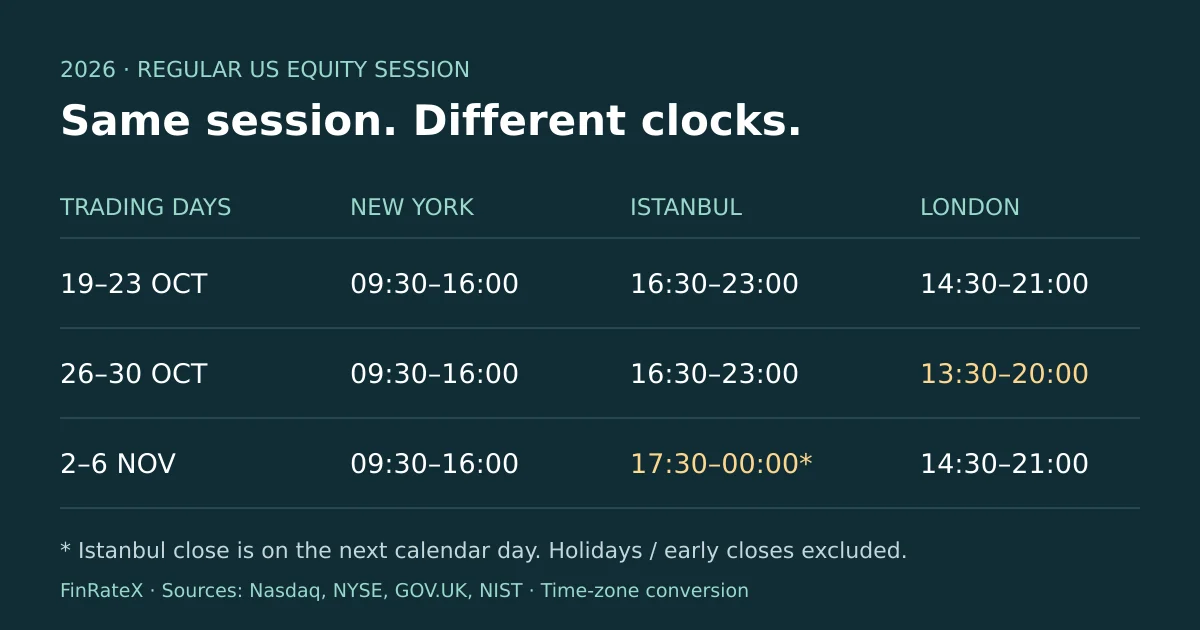
The short answer: Nasdaq and NYSE regular equity hours are 09:30–16:00 in New York. In Istanbul that means 16:30–23:00 through Friday, October 30, 2026, then 17:30–00:00 the following day on regular winter trading days from Monday, November 2. The clock change does not itself change returns, company value or the session’s 6.5-hour duration.
Two different Sundays
- October 25: the UK moves from BST to GMT. Türkiye does not turn its clocks back.
- October 26–30: New York remains on daylight time. The US regular session is 16:30–23:00 in Istanbul and 13:30–20:00 in London.
- November 1: New York returns to standard time. On November 2, the first normal weekday session, Istanbul hours become 17:30–00:00 the following day.
One US regular equity session, three local clocks
This is the London-time equivalent of Nasdaq/NYSE regular equity hours, not the London Stock Exchange’s session. Each row covers the stated normal trading days in 2026.
| Period | New York | Istanbul | London |
|---|---|---|---|
| October 19–23 | 09:30–16:00 EDT | 16:30–23:00 | 14:30–21:00 BST |
| October 26–30 | 09:30–16:00 EDT | 16:30–23:00 | 13:30–20:00 GMT |
| November 2–6 | 09:30–16:00 EST | 17:30–00:00 (+1 day) | 14:30–21:00 GMT |
Will Türkiye turn its clocks back?
No. Türkiye uses UTC+3 throughout the year. A New York or London clock changing is not a reason to manually alter an Istanbul device clock. Selecting Europe/Istanbul in a calendar is safer than applying a fixed ‘ET plus seven hours’ rule all year. For New York, ET means EDT in summer and EST in winter; its UTC offset is not constant across dates.
Why is there a one-week mismatch?
The two centres do not change on the same Sunday. The UK repeats 01:00 when its local clock reaches 02:00 on October 25; New York makes that rollback at local 02:00 on November 1. During the intervening week the London–New York gap temporarily narrows to four hours. This is the same instant displayed on different clocks, not an exchange moving its opening bell. Not all countries or US regions follow identical daylight-saving rules.
Which trading date owns the midnight close?
A regular US session beginning at 17:30 Istanbul time on Monday, November 2 ends at 00:00 on Tuesday, November 3 in Türkiye; the New York close is still Monday, November 2 at 16:00. A screen may show midnight while labelling the trading day with the New York date. When comparing daily returns or closing data, check both the exchange trading date and the provider timestamp. This conversion does not separately determine settlement or tax dates.
Does the table include pre-market and after-hours trading?
No. Nasdaq publishes separate windows outside regular equity hours, and a broker may not provide access to all of them. Accepting an order is also different from executing it in the market. Extended sessions can involve lower liquidity, wider bid–ask spreads and different order rules. Do not treat the regular equity close as a universal deadline for all options, CME contracts or broker products.
How should earnings and macro alerts be scheduled?
Keep the source time zone from the announcement, then convert for the specific date. As a time-only example, a hypothetical 08:30 New York release corresponds to 15:30 in Istanbul on October 30 and 16:30 on November 2. This does not claim a release is scheduled on either date. A company saying ‘after the market close’ is not giving an exact minute; track the results release and conference call separately.
Practical implications for a portfolio or business
A one-hour shift can affect monitoring shifts, meeting invitations and news alerts; it is not itself a reason to buy or sell. Read the price of a US equity or tracking fund alongside whether the underlying session is open. A fund’s valuation, dealing cutoff and settlement terms remain separate. Do not substitute BIST’s calendar for the US calendar: a local holiday such as October 29 can break the assumption that both markets are open on the same day.
Limits of this conversion
The table compares regular weekday US equity sessions; holiday and early-close schedules take precedence. November 1 being a Sunday does not mean the equity exchange trades that day. Intraday halts, product-specific rules and broker access require separate checks. No price, return, withholding-tax or commission calculation is made here. This is not investment advice.
 Gold, energy and commodities
 Gold, energy and commodities
 Gold, energy and commodities