When is the US jobs report? September 2026 nonfarm payrolls time and market signals
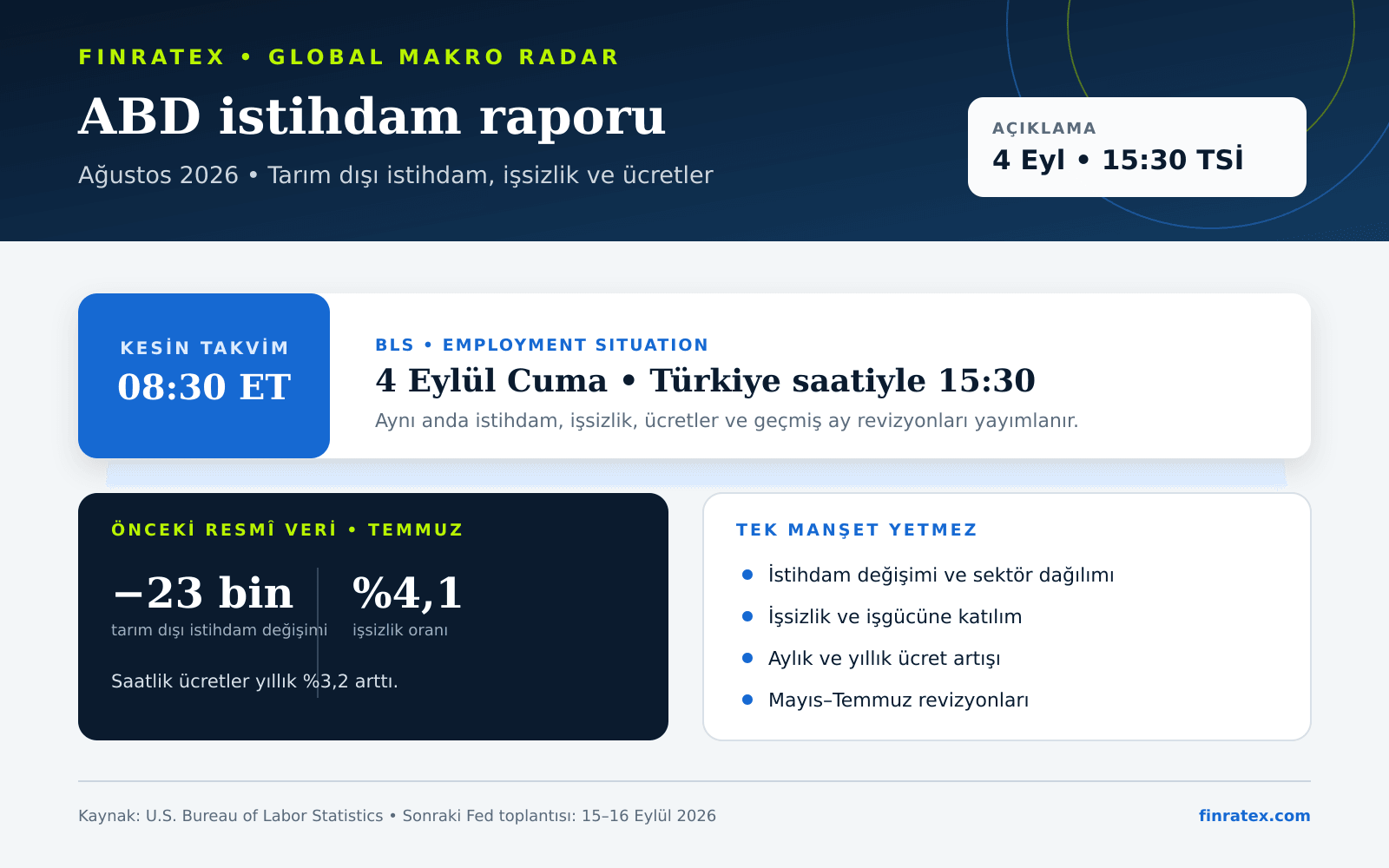
The August US Employment Situation report will be published on Friday, September 4 at 8:30 AM ET. Payrolls are only the first line: unemployment, wages, participation and revisions may also influence market pricing before the September 15–16 Federal Reserve meeting.
In this article
Quick answer: when is the US jobs report?
The US Bureau of Labor Statistics will publish the August 2026 Employment Situation report on Friday, September 4 at 8:30 AM Eastern Time. That is 12:30 UTC. Nonfarm payrolls, the unemployment rate and average hourly earnings will be released in the same report. The official BLS schedule confirms the timing; numbers circulated before publication are forecasts, not official results.
What do nonfarm payrolls measure?
Nonfarm payrolls measure the monthly change in employees on the payrolls of US businesses and government agencies, excluding farm workers, private household employees and several small groups. The figure comes from the establishment survey. The unemployment rate comes from a separate household survey, so payrolls and unemployment can move in different directions in the same month.
What happened in the previous report?
BLS reported that nonfarm payroll employment fell by 23,000 in July 2026, compared with an average monthly gain of 34,000 over the previous 12 months. The unemployment rate was 4.1% and labor-force participation was 61.4%. Average hourly earnings increased 3.2% from a year earlier. May and June payroll gains were revised down by a combined 103,000, making revisions another important part of the September 4 release.
Which five lines will markets watch?
The first is the monthly payroll change; the second is unemployment; the third is monthly and annual wage growth; the fourth is labor-force participation; and the fifth is revisions to prior months. Strong employment with accelerating wages carries a different inflation and Fed signal from weaker hiring with softer wages. A Reuters survey published September 2 showed a median payroll forecast of 56,000; it is not an official BLS forecast or an actual result.
Why do gold, the dollar and Treasury yields react?
Stronger-than-expected jobs and wages can, all else equal, reinforce expectations that the Fed will keep policy tighter, supporting the dollar and yields while creating a headwind for non-yielding gold. A weaker report can trigger the opposite repricing. Oil, geopolitics and market positioning can overwhelm the textbook response, however, so one release does not guarantee direction. On September 2, rising oil and yields were already weighing on gold as investors awaited the report.
What is the transmission to equities and Bitcoin?
For equities, the first channel is the global risk-free rate used in valuation; the second is the effect of labor costs and demand on earnings. Banks, exporters and domestic-demand companies need not react alike. Bitcoin and technology shares can be sensitive to discount rates and liquidity expectations, although risk demand, energy shocks and company-specific news may dilute the macro signal. Persistence and market breadth matter as much as the initial move.
Why does the report matter before the Fed decision?
The Federal Reserve's 2026 calendar places the next FOMC meeting on September 15–16, with a new Summary of Economic Projections. The August jobs report is one of the major labor-market inputs available before that meeting. The Fed does not respond to payrolls alone; unemployment, wages, participation, inflation and financial conditions are assessed together. This guide is for information only and is not investment advice.
Related analysis
All news → Gold, energy and commodities
Fed minutes are out: what comes next for gold and the dollar after 3.75%–4% rates?
 Gold, energy and commodities
Fed raises rates 25 basis points: new target is 3.75%–4.00%
 Gold, energy and commodities