Türkiye’s $4.053bn August current-account surplus: why the annual deficit is still $42.1bn
Türkiye posted a $4.053bn August surplus but a $42.1bn trailing deficit. We separate time windows, services, financing and the latest revised July balance.
In this article

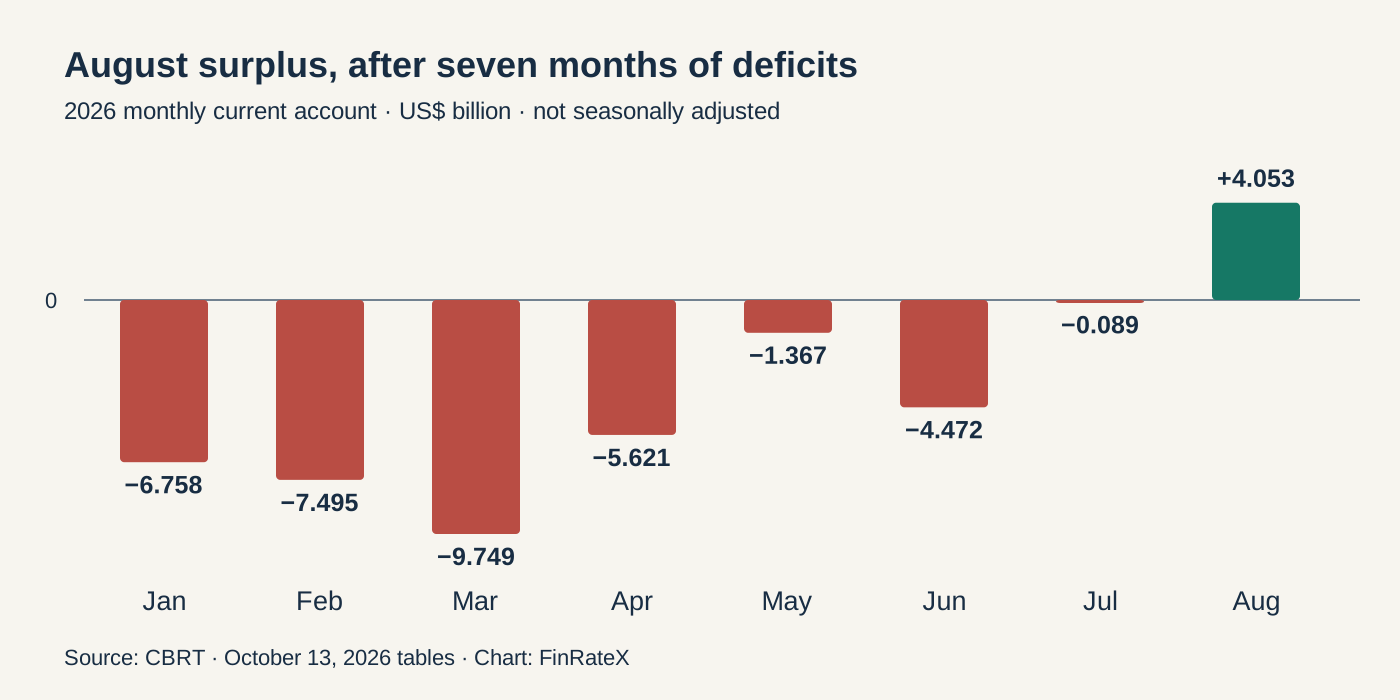
Türkiye recorded a $4.053 billion current-account surplus in August. The CBRT’s October 13 release shows a $9.711 billion services surplus alongside a $3.746 billion goods deficit for the month. That monthly result does not eliminate the deficits accumulated earlier: the trailing 12-month balance remains approximately $42.1 billion in deficit.
Three time windows in the same release
Positive means surplus; negative means deficit. Values are in billions of dollars. Do not add overlapping periods together.
| Indicator | Period | Balance | What it measures |
|---|---|---|---|
| Current account | August 2026 | +4.053 | One month |
| Current account | January–August 2026 | −31.498 | Year-to-date accumulation |
| Current account | September 2025–August 2026 | Approximately −42.1 | Trailing 12-month total |
| Current account | July 2026 | −0.089 | Latest value in the October 13 tables |
| Current account | August 2025 | +4.622 | Same-month comparison |
| Current account excluding gold and energy | August 2026 | +8.205 | A narrower-coverage indicator |
A monthly surplus and an annual deficit are compatible
The monthly result totals August transactions alone. The trailing figure includes every month from the previous September. A summer surplus supported by strong services receipts can offset earlier deficits only by its own amount. One month turning positive is therefore different from a lasting reduction in external financing needs. The first is an observed period result; the second is a trend that requires a longer sequence of evidence.
The latest July balance is a deficit, not a surplus
The CBRT’s current tables put July at an $89 million deficit. August’s surplus is also $569 million smaller than the August 2025 surplus: 4.622 minus 4.053 billion. These two checks show why a previous headline or an earlier first-release figure is not enough. Nor should the size of the month-to-month improvement be presented as a seasonally adjusted measure of acceleration.
Why the gold-and-energy exclusion is a separate number
The $8.205 billion measure removes the effect of gold and energy trade. It does not mean the country actually recorded that surplus: the headline is $4.053 billion. The $4.152 billion difference is the combined gold-and-energy effect. It cannot establish oil’s individual contribution or how many tonnes of gold the CBRT bought or sold. Central-bank gold reserves and trade in non-monetary gold measure different things.
A surplus does not mean inflows through every capital channel
The same release records $1.034 billion of net portfolio outflows and a $7.138 billion increase in official reserves. The current and financial accounts describe different transaction groups; reserve movements need to be read alongside both and the other balancing items. It would therefore be wrong to assign the entire reserve increase to one component, or equate a reserve transaction flow with the change in the gross reserve stock.
What businesses and savers can take from the release
A national surplus does not guarantee an exporter’s customer payment or promise an importer cheaper foreign currency. A company’s currency needs depend on sales denomination, input costs and debt maturities together. Similarly, the release is not a rule determining tomorrow’s dollar, gold or BIST direction. The useful question for a saver monitoring the external balance is which receipts generated the surplus and whether they persist across a longer period.
Calculation notes
The comparison uses the October 13, 2026 data vintage. Table amounts in millions of dollars were divided by 1,000 to express billions. The monthly chart is not seasonally adjusted; the 12-month amount is the CBRT’s rounded figure. The $569 million and $4.152 billion differences are FinRateX calculations. No exchange-rate forecast, securities return or investment recommendation was produced.
 Global economy
 Global economy
 Global economy