Over TRY 800 billion moved into deposits: what the CBRT changed and why it matters
Governor Karahan said fund outflows moved largely into deposits. We separate the TRY 800 billion shift from the CBRT's liquidity measures and their limits.
In this article

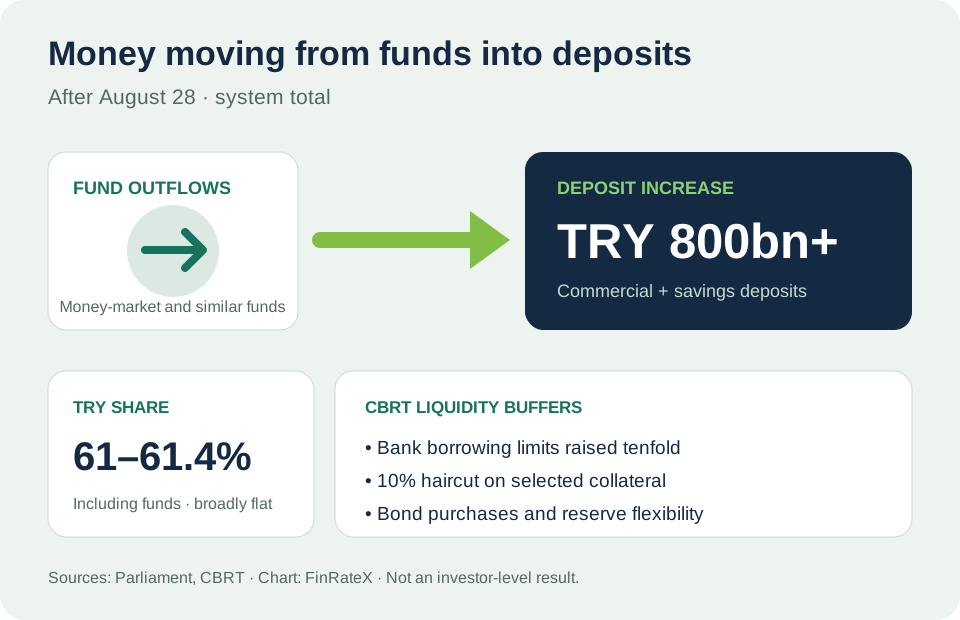
CBRT Governor Fatih Karahan said money-market and similar funds experienced substantial outflows after August 28, while commercial and savings deposits rose by more than TRY 800 billion over the same period. This system-level total does not prove that every investor moved the same product or all of their money.
The liquidation scope, investor count and payment process answer a separate search intent. This article focuses on the banking system and monetary-transmission effects of the outflows.
Three critical developments
- Karahan said a large share of fund outflows went into deposits; the total TRY share including funds remained broadly flat around 61–61.4%.
- The CBRT raised banks' borrowing limits tenfold, cut haircuts on selected collateral to 10% and accelerated bond purchases.
- The central bank said current data did not indicate systemic risk; that does not mean every liquidated fund has recovered or that deposits guarantee risk-free returns.
Rate transmission across three official dates
Simple annual rates in the CBRT presentation. The loan series exclude zero-interest products and the stated exceptions.
| Indicator | Feb 27 | Aug 7 | Sep 25 |
|---|---|---|---|
| CBRT weighted funding cost | 37.0% | 40.0% | 37.0% |
| 1–3 month TRY deposit | 37.3% | 39.8% | 36.9% |
| TRY commercial loan | 38.5% | 42.7% | 40.9% |
| Consumer loan | 48.4% | 52.2% | 50.8% |
What period and products does TRY 800 billion cover?
According to Parliament's official record, Karahan said money-market and similar funds saw substantial outflows after August 28, while commercial and savings deposits rose by more than TRY 800 billion over the same period. It is a gross system total. It does not prove that every fund redemption moved directly and one-for-one into deposits or that each investor transferred all their money.
Did investors abandon the lira?
Karahan said some money leaving foreign-currency funds could move into foreign-currency deposits, yet the overall currency mix remained consistent with the existing TRY share. In the CBRT presentation, the share was 61.4% on September 25 after fund portfolios were split by currency; his remarks described a 61–61.4% range. A flat aggregate share does not mean every investor selected only TRY deposits.
Which liquidity measures did the CBRT take?
Parliament's record identifies four channels: larger repo operations, a tenfold increase in banks' borrowing limits, a reduction to 10% in haircuts on inflation-linked and foreign-currency collateral, and a lower blocked share of banks' TRY required reserves. Bond purchases were also accelerated to limit spillover into money-market funds and risks linked to TLREF.
Why read deposit and lending rates together?
The CBRT's September 25 reference shows 36.9% for 1–3 month TRY deposits, 40.9% for TRY commercial loans and 50.8% for consumer loans. Deposit inflows can expand banks' funding base, but lending rates also reflect risk, capital, maturity and regulation. The TRY 800 billion increase therefore does not imply an automatic decline in loan pricing.
What does TRY 100,000 produce over 32 days?
Applying the 36.9% simple gross annual rate to TRY 100,000 for 32 days solely to show scale gives about TRY 3,235.07 gross interest. Assuming the Revenue Administration guide's 17.5% withholding rate for TRY deposits of up to six months leaves about TRY 2,668.93. This is not a bank offer; rate, value date, maturity, tax status and campaign conditions may differ.
MY MONEY · Fund versus deposit cannot be reduced to one rate
A deposit's maturity and stated gross rate may be more visible in advance; a fund's return depends on its portfolio value and market moves. Check early withdrawal, withholding and insurance coverage for deposits, and settlement, management fees, liquidity and portfolio risk for funds. Do not equate a fund in liquidation with the normal dealing terms of every fund in the market.
MY BUSINESS · A liquidity buffer is not loan approval
Easier access to central-bank liquidity can help protect payments and market functioning. It does not guarantee a company's loan application, a higher limit or a lower rate. Businesses should compare their cash-conversion cycle, loan term, collateral and total written cost together.
MY PORTFOLIO · How should the systemic-risk statement be read?
The CBRT said the three investment banks represented 0.2% of the sector in August and did not expect systemic risk on current evidence. That is a macro assessment of limited connectedness, not a guarantee of a fund's recovery rate, timing or a security's price. Institution, fund type, maturity and liquidity concentration remain separate portfolio risks.
Calculation notes
The TRY 800 billion, 61–61.4%, tenfold and 0.2% figures come from Parliament's official October 6 report; rate series come from the CBRT presentation. The TRY 100,000 example uses principal × rate × 32/365 and assumes 17.5% withholding for short-term TRY deposits. Compounding, bank fees, fund fees, inflation and product-specific differences are excluded. This is not investment advice.
 Money and banking
 Global economy
 Money and banking